at the CNIO

Category: Publications (Page 13 of 19)

Limited survival and impaired hepatic fasting metabolism in mice with constitutive Rag GTPase signaling

Celia de la Calle Arregui, Ana Belén Plata-Gómez, Nerea Deleyto-Seldas, Fernando García, Ana Ortega-Molina, Julio Abril-Garrido, Elena Rodriguez, Ivan Nemazanyy, Laura Tribouillard, Alba de Martino, Eduardo Caleiras, Ramón Campos-Olivas, Francisca Mulero, Mathieu Laplante, Javier Muñoz, Mario Pende, Guadalupe Sabio, David M. Sabatini & Alejo Efeyan.

The mechanistic target of rapamycin complex 1 (mTORC1) integrates cellular nutrient signaling and hormonal cues to control metabolism. We have previously shown that constitutive nutrient signaling to mTORC1 by means of genetic activation of RagA (expression of GTP-locked RagA, or RagAGTP) in mice resulted in a fatal energetic crisis at birth.

mTORC1 in adaptation to fasting.

Herein, we rescue neonatal lethality in RagAGTP mice and find morphometric and metabolic alterations that span glucose, lipid, ketone, bile acid and amino acid homeostasis in adults, and a median lifespan of nine months. Proteomic and metabolomic analyses of livers from RagAGTP mice reveal a failed metabolic adaptation to fasting due to a global impairment in PPAR? transcriptional program. These metabolic defects are partially recapitulated by restricting activation of RagA to hepatocytes, and revert by pharmacological inhibition of mTORC1. Constitutive hepatic nutrient signaling does not cause hepatocellular damage and carcinomas, unlike genetic activation of growth factor signaling upstream of mTORC1.

In summary, RagA signaling dictates dynamic responses to feeding-fasting cycles to tune metabolism so as to match the nutritional state.

Stress kinases in the development of liver steatosis and hepatocellular carcinoma

Beatriz Cicuéndez, Irene Ruiz-Garrido, Alfonso Mora & Guadalupe Sabio.

Non-alcoholic fatty liver disease (NAFLD) is an important component of metabolic syndrome and one of the most prevalent liver diseases worldwide. This disorder is closely linked to hepatic insulin resistance, lipotoxicity, and inflammation.

p38 pathway during liver steatosis
p38 pathway during liver steatosis.

Although the mechanisms that cause steatosis and chronic liver injury in NAFLD remain unclear, a key component of this process is the activation of stress-activated kinases (SAPKs), including p38 and JNK in the liver and immune system.

This review summarizes findings which indicate that the dysregulation of stress kinases plays a fundamental role in the development of steatosis and are important players in inducing liver fibrosis. To avoid the development of steatohepatitis and liver cancer, SAPK activity must be tightly regulated not only in the hepatocytes but also in other tissues, including cells of the immune system. Possible cellular mechanisms of SAPK actions are discussed.

Uncovering the role of p38 family members in adipose tissue physiology

Magdalena Leiva, Nuria Matesanz, Marta Pulgarín-Alfaro, Ivana Nikoli? & Guadalupe Sabio.

The complex functions of adipose tissue have been a focus of research interest over the past twenty years. Adipose tissue is not only the main energy storage depot, but also one of the largest endocrine organs in the body and carries out crucial metabolic functions. Moreover, brown and beige adipose depots are major sites of energy expenditure through the activation of adaptive, non-shivering thermogenesis.

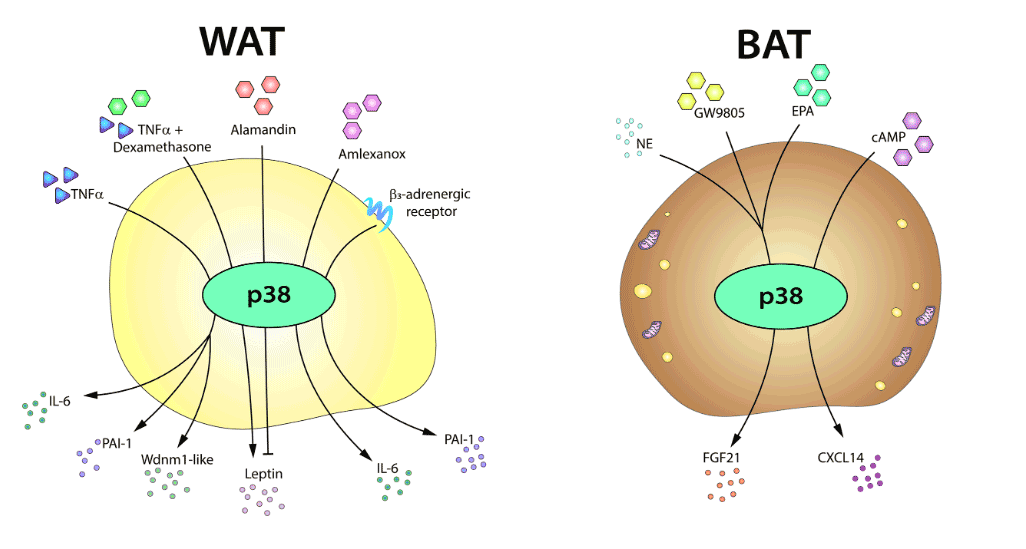
p38-mediated adipose tissue secretome
The p38-mediated adipose tissue secretome.

In recent years, numerous signaling molecules and pathways have emerged as critical regulators of adipose tissue, in both homeostasis and obesity-related disease. Among the best characterized are members of the p38 kinase family. The activity of these kinases has emerged as a key contributor to the biology of the white and brown adipose tissues, and their modulation could provide new therapeutic approaches against obesity.

Here, we give an overview of the roles of the distinct p38 family members in adipose tissue, focusing on their actions in adipogenesis, thermogenic activity, and secretory function.

« Older posts Newer posts »

© 2026 Sabio lab

Theme by Anders Norén — Up ↑