at the CNIO

Tag: lipid metabolism (Page 2 of 9)

Protein Kinase D2 modulates hepatic insulin sensitivity in male mice

Patricia Rada, Elena Carceller-López, Ana B. Hitos, Beatriz Gómez-Santos, Constanza Fernández-Hernández, Esther Re, Julia Pose-Utrilla, Carmelo García-Monzón, Águeda González-Rodríguez, Guadalupe Sabio, Antonia García, Patricia Aspichueta, Teresa Iglesias & Ángela M. Valverde.

Protein kinase D (PKD) family is emerging as relevant regulator of metabolic homeostasis. However, the precise role of PKD2 in modulating hepatic insulin signaling has not been fully elucidated and it is the aim of this study.

PKD2 controls insulin signaling in the liver at the level of IRS1.

PKD inhibition was analyzed for insulin signaling in mouse and human hepatocytes. PKD2 was overexpressed in Huh7 hepatocytes and mouse liver, and insulin responses were evaluated. Mice with hepatocyte-specific PKD2 depletion (PKD2ΔHep) and PKD2fl/fl mice were fed a chow (CHD) or high fat diet (HFD) and glucose homeostasis and lipid metabolism were investigated.

PKD2 silencing enhanced insulin signaling in hepatocytes, an effect also found in primary hepatocytes from PKD2ΔHep mice. Conversely, a constitutively active PKD2 mutant reduced insulin-stimulated AKT phosphorylation. A more in-depth analysis revealed reduced IRS1 serine phosphorylation under basal conditions and increased IRS1 tyrosine phosphorylation in PKD2ΔHep primary hepatocytes upon insulin stimulation and, importantly PKD co-immunoprecipitates with IRS1. In vivo constitutively active PKD2 overexpression resulted in a moderate impairment of glucose homeostasis and reduced insulin signaling in the liver. On the contrary, HFD-fed PKD2ΔHep male mice displayed improved glucose and pyruvate tolerance, as well as higher peripheral insulin tolerance and enhanced hepatic insulin signaling compared to control PKD2fl/fl mice. Despite of a remodeling of hepatic lipid metabolism in HFD-fed PKD2ΔHep mice, similar steatosis grade was found in both genotypes.

Results herein have unveiled an unknown role of PKD2 in the control of insulin signaling in the liver at the level of IRS1 and point PKD2 as a therapeutic target for hepatic insulin resistance.

DIDO is necessary for the adipogenesis that promotes diet-induced obesity

María Ángeles García-López, Alfonso Mora, Patricia Corrales, Tirso Pons, Ainhoa Sánchez de Diego, Amaia Talavera Gutiérrez, Karel H. M. van Wely, Gema Medina-Gómez, Guadalupe Sabio, Carlos Martínez-A, & Thierry Fischer.

The prevalence of overweight and obesity continues to rise in the population worldwide. Because it is an important predisposing factor for cancer, cardiovascular diseases, diabetes mellitus, and COVID-19, obesity reduces life expectancy. Adipose tissue (AT), the main fat storage organ with endocrine capacity, plays fundamental roles in systemic metabolism and obesity-related diseases. Dysfunctional AT can induce excess or reduced body fat (lipodystrophy). Dido1 is a marker gene for stemness; gene-targeting experiments compromised several functions ranging from cell division to embryonic stem cell differentiation, both in vivo and in vitro.

Reduced  body temperature in mutant ΔNT mice.
Reduced body temperature in mutant ΔNT mice (Image: Alfonso Mora).

We report that mutant mice lacking the DIDO N terminus show a lean phenotype. This consists of reduced AT and hypolipidemia, even when mice are fed a high-nutrient diet. DIDO mutation caused hypothermia due to lipoatrophy of white adipose tissue (WAT) and dermal fat thinning. Deep sequencing of the epididymal white fat (Epi WAT) transcriptome supported Dido1 control of the cellular lipid metabolic process. We found that, by controlling the expression of transcription factors such as C/EBPα or PPARγ, Dido1 is necessary for adipocyte differentiation, and that restoring their expression reestablished adipogenesis capacity in Dido1 mutants.

Our model differs from other lipodystrophic mice and could constitute a new system for the development of therapeutic intervention in obesity.

From beats to metabolism: the heart at the core of interorgan crosstalk

Rafael Romero-Becerra, Ayelén M. Santamans, Alba C. Arcones & Guadalupe Sabio.

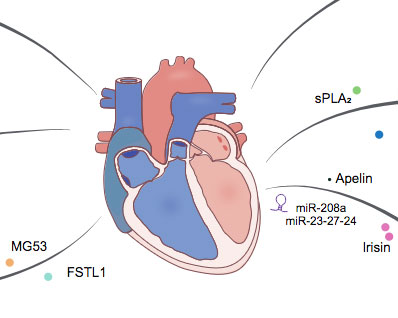
The heart, once considered a mere pump, is now recognized as a multifunctional metabolic and endocrine organ. Its function is tightly regulated by various metabolic processes, at the same time that serves as an endocrine organ, secreting bioactive molecules that impact systemic metabolism.

Altered cardiac secretome (Image: Rafael Romero-Becerra).

In recent years, research has shed light on the intricate interplay between the heart and other metabolic organs, such as adipose tissue, liver, and skeletal muscle. The metabolic flexibility of the heart and its ability to switch between different energy substrates play a crucial role in maintaining cardiac function and overall metabolic homeostasis. Gaining a comprehensive understanding of how metabolic disorders disrupt cardiac metabolism is crucial, as it plays a pivotal role in the development and progression of cardiac diseases. The emerging understanding of the heart as a metabolic and endocrine organ highlights its essential contribution to whole-body metabolic regulation and offers new insights into the pathogenesis of metabolic diseases, such as obesity, diabetes, and cardiovascular disorders.

In this paper, we provide an in-depth exploration of the heart’s metabolic and endocrine functions, emphasizing its role in systemic metabolism and the interplay between the heart and other metabolic organs. Furthermore, emerging evidence suggests a correlation between heart disease and cancer, indicating that the metabolic dysfunction observed in both conditions may share common underlying mechanisms. By unraveling the complex mechanisms underlying cardiac metabolism, we aim to contribute to the development of novel therapeutic strategies for metabolic diseases and improve overall cardiovascular health.

« Older posts Newer posts »

© 2026 Sabio lab

Theme by ¡Cuánta Cienia!Up ↑