at the CNIO

Tag: liver (Page 18 of 19)

Laboratory technician

Our group seeks a motivated lab technician with at least two years of experience in histology and genotyping.

The technician will be in charge of the preparation and staining of samples for histology and immunohistochemistry, genotyping of our mouse colony and helping the other members of the lab with their experiments.

We offer a work is an international project currently in expansion developed in an environment with a solid commitment to excellent research

Deadline: 3 October 2017

For more information and application, please visit CNIC’s website.

brown fat

H&E staining of murine brown fat (Photo: Nuria Matesanz/CNIC).

Hypothalamic AMPK-ER stress-JNK1 axis mediates the central actions of thyroid hormones on energy balance

Noelia Martínez-Sánchez, Patricia Seoane-Collazo, Cristina Contreras, Luis Varela, Joan Villarroya, Eva Rial-Pensado, Xabier Buqué, Igor Aurrekoetxea, Teresa C. Delgado, Rafael Vázquez-Martínez, Ismael González-García, Juan Roa, Andrew J. Whittle, Beatriz Gomez-Santos, Vidya Velagapudi, Y.C. Loraine Tung, Donald A. Morgan, Peter J. Voshol, Pablo B. Martínez de Morentin, Tania López-González, Laura Liñares-Pose, Francisco Gonzalez, Krishna Chatterjee, Tomás Sobrino, Gema Medina-Gómez, Roger J. Davis, Núria Casals, Matej Oreši?, Anthony P. Coll, Antonio Vidal-Puig, Jens Mittag, Manuel Tena-Sempere, María M. Malagón, Carlos Diéguez, María Luz Martínez-Chantar, Patricia Aspichueta, Kamal Rahmouni, Rubén Nogueiras, Guadalupe Sabio, Francesc Villarroya & Miguel López.
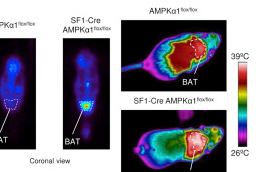
Pathway proposed to modulate lipid metabolism in liverThyroid hormones (THs) act in the brain to modulate energy balance. We show that central triiodothyronine (T3) regulates de novo lipogenesis in liver and lipid oxidation in brown adipose tissue (BAT) through the parasympathetic (PSNS) and sympathetic nervous system (SNS), respectively. Central T3 promotes hepatic lipogenesis with parallel stimulation of the thermogenic program in BAT.

The action of T3 depends on AMP-activated protein kinase (AMPK)-induced regulation of two signaling pathways in the ventromedial nucleus of the hypothalamus (VMH): decreased ceramide-induced endoplasmic reticulum (ER) stress, which promotes BAT thermogenesis, and increased c-Jun N-terminal kinase (JNK) activation, which controls hepatic lipid metabolism. Of note, ablation of AMPK?1 in steroidogenic factor 1 (SF1) neurons of the VMH fully recapitulated the effect of central T3, pointing to this population in mediating the effect of central THs on metabolism.

Overall, these findings uncover the underlying pathways through which central T3 modulates peripheral metabolism.


Hepatic p63 regulates steatosis via IKK?/ER stress

Begoña Porteiro, Marcos F. Fondevila, Teresa C. Delgado, Cristina Iglesias, Monica Imbernon, Paula Iruzubieta, Javier Crespo, Amaia Zabala-Letona, Johan Fernø, Bárbara González-Terán, Nuria Matesanz, Lourdes Hernández-Cosido, Miguel Marcos, Sulay Tovar, Anxo Vidal, Julia Sánchez-Ceinos, Maria M. Malagon, Celia Pombo, Juan Zalvide, Arkaitz Carracedo, Xabier Buque, Carlos Dieguez, Guadalupe Sabio, Miguel López, Patricia Aspichueta, María L. Martínez-Chantar & Ruben Nogueiras.

Pathway proposed to modulate lipid metabolism in liverp53 family members control several metabolic and cellular functions. The p53 ortholog p63 modulates cellular adaptations to stress and has a major role in cell maintenance and proliferation.

Here we show that p63 regulates hepatic lipid metabolism. Mice with liver-specific p53 deletion develop steatosis and show increased levels of p63. Down-regulation of p63 attenuates liver steatosis in p53 knockout mice and in diet-induced obese mice, whereas the activation of p63 induces lipid accumulation. Hepatic overexpression of N-terminal transactivation domain TAp63 induces liver steatosis through IKK? activation and the induction of ER stress, the inhibition of which rescues the liver functions. Expression of TAp63, IKK? and XBP1s is also increased in livers of obese patients with NAFLD. In cultured human hepatocytes, TAp63 inhibition protects against oleic acid-induced lipid accumulation, whereas TAp63 overexpression promotes lipid storage, an effect reversible by IKK? silencing.

Our findings indicate an unexpected role of the p63/IKK?/ER stress pathway in lipid metabolism and liver disease.


« Older posts Newer posts »

© 2026 Sabio lab

Theme by Anders Norén — Up ↑