at the CNIO

Tag: muscle (Page 2 of 3)

Remodeling p38 signaling in muscle controls locomotor activity via IL-15

Cintia Folgueira, Leticia Herrera-Melle, Juan Antonio López, Victor Galvan-Alvarez, Marcos Martin-Rincon, María Isabel Cuartero, Alicia García-Culebras, Phillip A. Dumesic, Elena Rodríguez, Luis Leiva-Vega, Marta León, Begoña Porteiro, Cristina Iglesias, Jorge L. Torres, Lourdes Hernández-Cosido, Clara Bonacasa, Miguel Marcos, María Ángeles Moro, Jesús Vázquez, Jose A. L. Calbet, Bruce M. Spiegelman, Alfonso Mora & Guadalupe Sabio.

Skeletal muscle has gained recognition as an endocrine organ releasing myokines upon contraction during physical exercise. These myokines exert both local and pleiotropic health benefits, underscoring the crucial role of muscle function in countering obesity and contributing to the overall positive effects of exercise on health.

Active p38γ increases locomotor activity (Image: Cintia Folgueira).

Here, we found that exercise activates muscle p38γ, increasing locomotor activity through the secretion of interleukin-15 (IL-15). IL-15 signals in the motor cortex, stimulating locomotor activity. This activation of muscle p38γ, leading to an increase locomotor activity, plays a crucial role in reducing the risk of diabetes and liver steatosis, unveiling a vital muscle-brain communication pathway with profound clinical implications. The correlation between p38γ activation in human muscle during acute exercise and increased blood IL-15 levels highlights the potential therapeutic relevance of this pathway in treating obesity and metabolic diseases.

These findings provide valuable insights into the molecular basis of exercise-induced myokine responses promoting physical activity.

From beats to metabolism: the heart at the core of interorgan crosstalk

Rafael Romero-Becerra, Ayelén M. Santamans, Alba C. Arcones & Guadalupe Sabio.

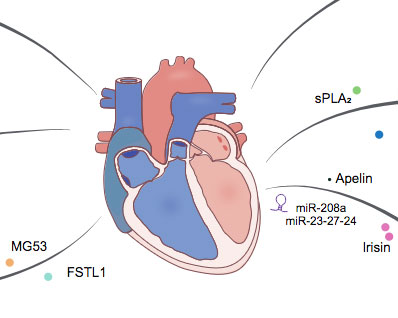
The heart, once considered a mere pump, is now recognized as a multifunctional metabolic and endocrine organ. Its function is tightly regulated by various metabolic processes, at the same time that serves as an endocrine organ, secreting bioactive molecules that impact systemic metabolism.

Altered cardiac secretome (Image: Rafael Romero-Becerra).

In recent years, research has shed light on the intricate interplay between the heart and other metabolic organs, such as adipose tissue, liver, and skeletal muscle. The metabolic flexibility of the heart and its ability to switch between different energy substrates play a crucial role in maintaining cardiac function and overall metabolic homeostasis. Gaining a comprehensive understanding of how metabolic disorders disrupt cardiac metabolism is crucial, as it plays a pivotal role in the development and progression of cardiac diseases. The emerging understanding of the heart as a metabolic and endocrine organ highlights its essential contribution to whole-body metabolic regulation and offers new insights into the pathogenesis of metabolic diseases, such as obesity, diabetes, and cardiovascular disorders.

In this paper, we provide an in-depth exploration of the heart’s metabolic and endocrine functions, emphasizing its role in systemic metabolism and the interplay between the heart and other metabolic organs. Furthermore, emerging evidence suggests a correlation between heart disease and cancer, indicating that the metabolic dysfunction observed in both conditions may share common underlying mechanisms. By unraveling the complex mechanisms underlying cardiac metabolism, we aim to contribute to the development of novel therapeutic strategies for metabolic diseases and improve overall cardiovascular health.

« Older posts Newer posts »

© 2026 Sabio lab

Theme by Anders NorenUp ↑